Elaine Ellinger Exposes the Formation of the Islamic Mind
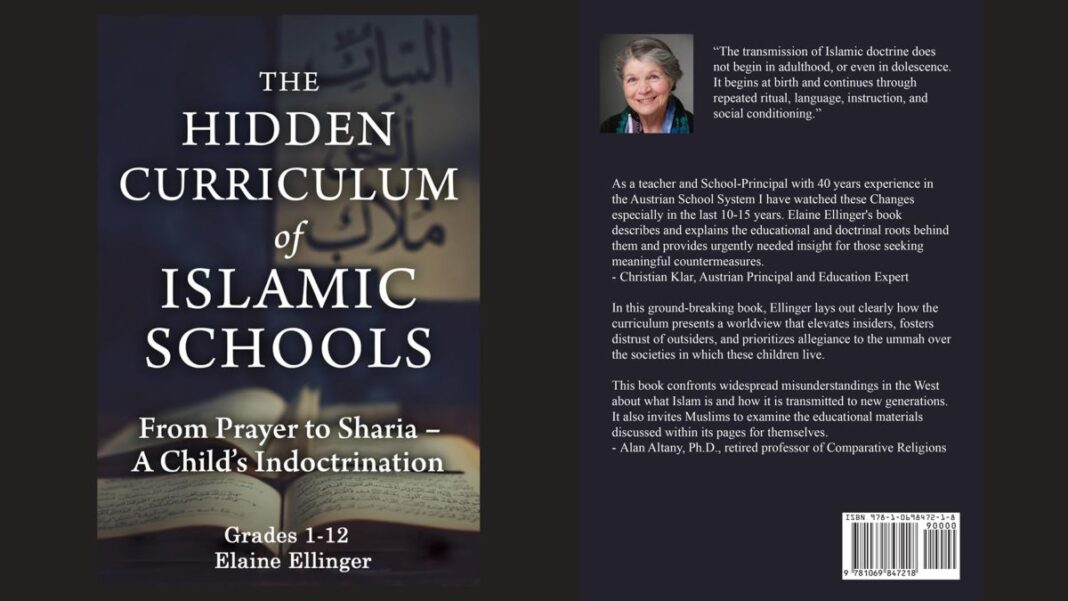
Every civilization teaches its children what to love, what to fear, what to obey, and what to regard as sacred. The decisive instruction often occurs beneath the formal lesson. A child may appear to be learning prayers, stories, manners, and vocabulary while absorbing a far more comprehensive understanding of authority, identity, loyalty, law, and the surrounding world. Elaine Ellinger’s The Hidden Curriculum of Islamic Schools: From Prayer to Sharia—A Child’s Indoctrination is a formidable attempt to uncover that deeper education.
Ellinger has undertaken a task from which most Western institutions instinctively retreat. She has examined an English-language Islamic Studies curriculum spanning Grades 1 through 12, together with widely circulated supplementary texts, and asked the most elementary question imaginable: What are children actually being taught?
The answer occupies nearly three hundred pages and is assembled with remarkable diligence. Ellinger follows the curriculum grade by grade, tracing the accumulation of doctrine from early ritual instruction through increasingly explicit lessons concerning sharia, communal allegiance, Islamic governance, jihad, conquest, martyrdom, relations with non-Moslems, and the authority of Mohammed as an enduring model of conduct. Her achievement lies in demonstrating that these subjects do not suddenly appear in adolescence. They are prepared gradually through language, repetition, memorization, habit, emotional identification, and carefully selected history.
The book’s structure is one of its great strengths. Each grade is examined under recurring categories: binding precedent; conflicts and omissions; superiority messaging; group identity and boundary formation; and behavioral conditioning through ritual practice. This method enables Ellinger to follow ideas as they develop over time. A prayer learned at six acquires legal meaning at sixteen. A story of persecution becomes part of a civilizational narrative. The imitation of Mohammed’s personal habits eventually expands into the acceptance of his political, judicial, and military authority.
Ellinger’s governing insight concerns precedent. The episodes described in Islamic textbooks are presented to children as more than remote religious history. Mohammed’s conduct and the actions of his companions carry normative force. Battles, treaties, punishments, marriages, political decisions, and relations with rival communities become models of behavior rooted in revelation and tradition. The distinction is indispensable. A modern student reading about Caesar crossing the Rubicon encounters history; a Moslem child studying Mohammed may encounter an example to be revered and followed. Ellinger therefore describes this material as “binding precedent,” a phrase that illuminates the entire book.
The early grades reveal the process in miniature. Children learn prescribed phrases for waking, sleeping, eating, dressing, washing, entering the home, leaving it, entering the lavatory, and preparing for prayer. They learn which foot should move first and which hand should perform particular tasks. Such details may appear innocuous when considered separately. Ellinger’s cumulative treatment shows their larger purpose: daily life is progressively enclosed within a continuous system of religious obligation.
Ritual has always been central to religious formation. Ellinger’s concern arises from the direction in which this formation leads. The child learns obedience before possessing the intellectual maturity to examine the authority being obeyed. Memorization precedes comprehension. Arabic passages are internalized before their implications are explained. The habits of submission become instinctive, while the doctrines that justify them arrive gradually.
This is where the book becomes especially powerful. Ellinger does not confine herself to what the curriculum includes. She examines what it withholds, softens, postpones, or recasts. Mohammed is introduced through stories of kindness, patience, honesty, generosity, and persecution. Later lessons present military expansion, political supremacy, captives, spoils, punishment, and the subordination of opponents within a moral framework already secured by childhood admiration. The guileful effectiveness of the sequence lies in its gradualism. The child first learns whom to love; the authority of everything that person later does follows more easily.
Ellinger also scrutinizes the curriculum’s treatment of Jews, Christians, and other non-Moslems. She identifies recurring messages that divide humanity into believers and disbelievers, the guided and the misguided, the best of creatures and the worst. Familiar terms such as peace, justice, equality, and truth may appear throughout the lessons, yet Ellinger insists that readers examine the doctrinal meanings assigned to those words. Equality within the community of believers differs from universal equality before secular law. Peace under divine order differs from pluralistic coexistence among competing systems.
Her discussion of deen supplies the intellectual center of the book. Western societies habitually classify Islam as a religion resembling Christianity or Judaism: a body of belief, worship, and private devotion existing within a larger secular order. The curriculum describes Islam as deen, a complete way of life encompassing religion, law, commerce, morality, politics, justice, clothing, food, social relations, and public authority. Sharia appears as the practical expression of that comprehensive order.
This single distinction explains much of the Western imbroglio surrounding Islamic institutions. Policymakers defend freedom of religion while failing to investigate whether the system seeking accommodation claims authority over matters the West assigns to civil law, democratic government, private conscience, and individual choice. An institution may be treated as a house of worship while teaching a civilizational structure that recognizes no permanent boundary between mosque and state.
Ellinger’s analysis of prophetic narratives further sharpens the point. Western readers commonly approach prophets through the image of the moral teacher who warns rulers, calls individuals to repentance, or suffers for truth. The Quranic curriculum often presents prophets as governors, judges, commanders, destroyers of idols, and enforcers of divine authority. Within that tradition, Mohammed’s leadership of armies and establishment of a state appear neither anomalous nor embarrassing. They complete an established pattern.
The book also examines supplementary texts devoted to Islamic history, apologetics, proselytization, and claims of scientific miracles in the Quran. Ellinger challenges inflated accounts in which Islamic civilization appears to have independently created vast domains of scientific knowledge while Greek, Persian, Indian, Syriac Christian, and other contributions recede from view. She is especially effective when showing how educational materials convert genuine historical achievements into assertions of religious superiority.
Some readers will find the book’s conclusions severe. Ellinger writes with urgency, and occasionally with a lugubrious sense of what Western negligence has permitted. Her alarm, however, emerges from the material she has assembled. She has not produced a collection of impressions gathered from inflammatory speeches or isolated incidents. She has examined a systematic educational program that begins with young children and continues through the threshold of adulthood.
A study of this scope inevitably invites verification and debate. Individual historical claims, translations, interpretations, and applications of jurisprudence should be examined carefully by scholars with the relevant linguistic and textual expertise. Ellinger herself encourages readers to verify the references independently. That invitation strengthens the book. She has placed a large body of material before the public and challenged defenders of the curriculum to answer it from the texts rather than retreating into accusations about motive.
Her moral concern throughout remains the child. The dedication expresses the hope that children may “live free, laugh often, dance without fear, and feel the sun on their faces.” That image gives the book its human center. Ellinger regards children as the first subjects of an ideological system they are too young to evaluate and later may find extraordinarily difficult to question. The imprint can become indelible precisely because it is made before independence of mind has fully formed.
The West’s response to Islamic education has largely alternated between incuriosity and fear. Officials praise diversity, approve schools, extend accommodations, and invoke tolerance while rarely examining the doctrines being transmitted. When conflict later enters public life, institutions treat it as an inexplicable departure from benign religious teaching. Ellinger argues that the trajectory is already visible in the curriculum.
Her conclusion is ineluctable: education shapes allegiance. A society that permits schools to cultivate a governing identity superior to citizenship should expect that identity to influence future political and social conduct. Liberal democracy cannot preserve itself through ignorance of what its future citizens are being taught about law, authority, outsiders, and the legitimacy of the society around them.
The Hidden Curriculum of Islamic Schools is therefore more than an exposé of textbooks. It is a warning about civilizational illiteracy. Elaine Ellinger has opened the classroom door and invited the West to look inside. Our governing institutions may dispute her conclusions. They can no longer plausibly claim that the curriculum was hidden from view.