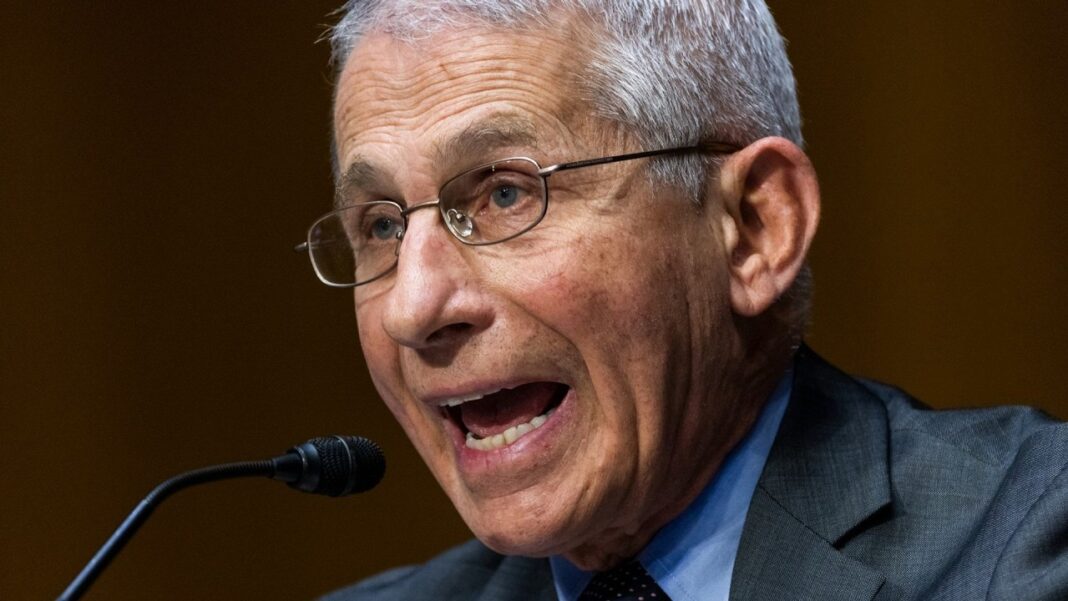
For two years, Dr. Anthony Fauci told Americans that to doubt him was to doubt science itself. On Wednesday, under subpoena before the Senate Homeland Security and Governmental Affairs Committee, America’s most powerful public-health official delivered a different message. He said nothing, 111 times.
Question after question, he gave the same rehearsed line: “On the advice of counsel, I respectfully decline to answer based upon my rights under the Fifth Amendment.” Not about the pandemic he managed. Not about the virus’s origins. Not about the response that shut down the country. In more than 200 prior appearances before Congress, he had never once taken the Fifth. Wednesday, he took it until the committee lost count.
Then Sen. Josh Hawley, former Missouri attorney general, dropped the pretense that any of this was about the Constitution. He asked what day of the week it was. The Fifth. What color tie Fauci was wearing. The Fifth. What color the carpet was beneath his feet. The Fifth. The man who assured 330 million Americans he could read a virus’s molecular future couldn’t, under oath, name the color of the floor.
“You don’t have any rights under the Fifth Amendment, because you’ve been pardoned, as you very well know,” Hawley pressed, citing Supreme Court precedent that a pardoned witness may not “stand upon his privilege.” Then the knife: “You’ve done more to harm science than anybody in my lifetime. And I hope you’ll go home and write that in your diary.”
Look at the record.
Start with the pardon. In his final hours in office, Biden handed Fauci a “full and unconditional” preemptive pardon for federal conduct from 2014 through January 20, 2025. It was extraordinary clemency for a man never charged with anything. Fauci insisted he had “committed no crime.” Fair question: if he did nothing wrong, why the most sweeping personal pardon in modern memory, and then the Fifth on top of it?
Because the pardon has limits. It buries the past. It does nothing for the future. Say something false Wednesday and it becomes a new statement, a new potential crime, beyond the pardon’s reach. Health Secretary Robert F. Kennedy Jr. put it plainly: if Fauci “lies again, he could be subject to perjury prosecution.” Silence was the last shield he had. He hid behind it.
What is he so determined not to say? For years, Rand Paul has charged that Fauci misled Congress about U.S. funding of “gain-of-function” research at the Wuhan lab and helped bury early suspicion that the virus escaped it. Fauci denies it, resting on a technical definition critics call a semantic shell game. Yet NIH conceded in 2021 that an experiment it funded left lab mice sicker, and in late 2024 the Republican-led House coronavirus subcommittee found a lab leak the likeliest source of a virus that killed more than a million Americans. His own diaries, released this week, cut deeper. In January 2020, Paul says, Fauci privately doubted the Wuhan wet-market story, well before “lab leak” entered the public vocabulary, even as the country was steered toward a natural origin. Days later came the notorious “Proximal Origin” paper waving the theory away.
None of it touches what Americans lived: masks on then off, schools chained shut, childhoods and years no one gets back. And some lost more than years. In the season he led, hundreds of thousands died the way that season decreed: alone. Sedated behind sealed doors, a breathing tube where their voice used to be, visitors turned away at the threshold, their last moments held up on a nurse’s phone. No hand to hold. No final word. A ventilator does not permit one. Sons and daughters said goodbye to a muted screen and a chest that rose and fell until it didn’t.
They never got to “respectfully decline to answer.” They had no counsel to advise them into silence. They were silenced anyway. Fauci was in the room to speak and chose not to. The dead cannot plead the Fifth. They already surrendered everything the Constitution had to give.
So what now? Paul denied the privilege, ordered Fauci to answer, and warned that obstructing Congress “is against the law.” He set an August 5 committee vote on holding Fauci in contempt. He and Hawley argue that a pardoned man forfeits the Fifth, a theory Paul concedes has “probably never been tested.” The courts will now decide.
A pardon is not a gag order on history, and the Fifth Amendment is not a hall pass from the people whose lives were upended. Fauci may invoke his rights. But Americans may draw their own conclusions about a man who spent a career demanding their trust and given one chance to speak plainly under oath, could not bring himself to name the color of the carpet.
The science, it turns out, speaks for itself. Right up until it’s subpoenaed.