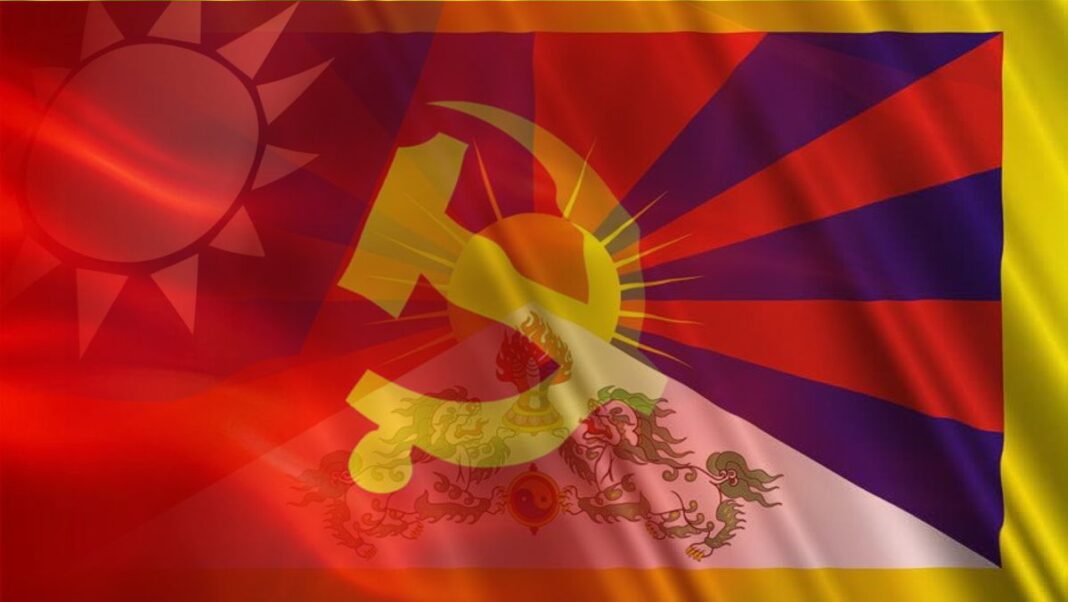
This essay reconstructs and evaluates the CCP’s own territorial consolidation doctrine concerning Tibet and Taiwan; it is not an endorsement of the underlying territorial claims, nor a prediction of a particular outcome for Taiwan
Commentators often describe Beijing’s approach to Tibet and to Taiwan as expressions of one doctrine of indivisible sovereignty. That claim is true at the level of strategic grammar and false at the level of feasibility. Taiwan sits inside an alliance system, a semiconductor supply chain, and a maritime chokepoint that Tibet in 1950 never touched, and it is this structural asymmetry, not any inconsistency in the Chinese Communist Party (CCP) intent, that explains why the “same road” has produced such different destinations.
The claim, disaggregated
Popular commentary collapses three separate claims into one image of a single road from Beijing through Lhasa to Taipei:
1. The CCP’s own narrative: both territories as unfinished chapters in “national rejuvenation.”
2. The historical record: Tibet’s 1950-51 incorporation and Taiwan’s post-1949 separation, which followed very different legal and military paths.
3. The reconstructable strategic logic: the sequence of legitimation, delegitimation of rivals, and multi-domain coercion an outside analyst can infer from behaviour, independent of what Beijing says about itself.
This essay treats (1) as an object of study, tests it against (2), and uses (3) to explain the gap between doctrine and outcome. The thesis: Tibet and Taiwan occupy entirely different positions in the structure of the international system, one landlocked and peripheral to global trade, the other a maritime chokepoint and the fulcrum of the world’s most consequential supply chain. That asymmetry, not doctrinal inconsistency, is what disciplines Beijing’s Taiwan strategy into something far more constrained than its Tibet strategy ever needed to be.
Why the doctrine looks consistent
Several IR frameworks explain the recurring pattern without needing to invoke different intentions. Ontological security theory (Jennifer Mitzen) treats a state’s need for a stable self-narrative as a driver independent of material gain, which is why Beijing’s reaction to a foreign meeting with the Dalai Lama, or a Taiwanese president’s US transit, is disproportionate to any tangible loss: the stake is narrative integrity, not territory. Coercive gradualism (“salami-slicing,” documented by Oriana Skylar Mastro in the South China Sea and Strait) describes accumulating below-threshold actions that shift a status quo without triggering decisive response. Escalation-ladder theory (Thomas C. Schelling, updated for cross-strait analysis by CSIS and RAND) reframes Beijing’s calculus as not “can we take Taiwan” but “at what rung does allied intervention become likely, and can objectives be met below it” – probing conducted incrementally because misjudgement is catastrophic in a way it never was in 1950 Tibet. Domestic legitimacy theory adds that irredentist rhetoric serves a one-party system’s need for unifying narrative, so intensity should track the Party’s internal calendar as much as cross-strait conditions, a pattern at least partly borne out historically.
No single framework fully explains the record; elements of all four appear simultaneously. That is itself the finding: the “same doctrine” claim is real but under-determined, and geopolitical constraint, not inconsistency, does most of the work in explaining why Taiwan policy looks so different from Tibet policy.
Tibet: territorial control secured, sovereignty over meaning still contested
The PLA’s 1950 entry and the 1951 Seventeen-Point Agreement are described by most historians, including Melvyn Goldstein, sympathetic to neither Beijing nor the exile government, as involving significant military duress. Beijing holds Tibet has “always” been part of China; most Western and Tibetan historians describe a more contested status of Qing-era suzerainty, de facto independence (1913-1950), and an incorporation lacking comparable consent.
What followed is uncontested: administrative restructuring (the 1965 Tibet Autonomous Region), the Qinghai-Tibet Railway (2006), Han in-migration, and, critically, an assertion of state authority over religious succession itself, formalized in the 2007 “reincarnation” measures and 2017 Religious Affairs Regulation.
This is live, not historical background. Ahead of his 90th birthday in 2025, the Dalai Lama reaffirmed that the Gaden Phodrang Trust alone holds legitimacy to recognize his reincarnation, explicitly outside Chinese jurisdiction; Beijing’s foreign ministry rejected any foreign role, citing the Qing-era Golden Urn as precedent. UN human rights experts raised formal concern in 2025 over both this mechanism and the decades-long disappearance of the 1995 Panchen Lama. Most Tibet specialists now expect a rival Beijing-anointed Dalai Lama once succession occurs.
Tibet is also India’s most sensitive frontier: the plateau borders the disputed Line of Actual Control, holds the headwaters of the Brahmaputra, Indus, and Mekong, and hosts the government-in-exile in Dharamshala. Delhi’s studied non-position on succession reflects awareness that Tibet is simultaneously a domestic Chinese matter and a live lever in Sino-Indian competition. So: territorial control was consolidated by the 1960s, but sovereignty over meaning (religious authority, historical memory, cross-border leverage), remains actively contested seven decades on.
Taiwan: the same doctrine, a different board
Taiwan diverges from Tibet at every structural level relevant to coercive strategy.
The First Island Chain. Taiwan sits at the centre of the maritime barrier (Japan through the Ryukyus, Taiwan, and the Philippines to Borneo), that constrains PLA Navy access to the open Pacific. Chinese control would puncture this chain and alter Western Pacific military geography for Japan, the Philippines, and the US Seventh Fleet. Tibet’s incorporation carried no comparable consequence for a rival power’s force posture.
Semiconductor centrality. TSMC fabricates the substantial majority of the world’s most advanced logic chips. Beyond deterrence (“silicon shield”), this internationalizes the stakes: a crisis would immediately implicate electronics, automotive, defense, and AI-compute supply chains across every advanced economy, a first-order concern for Washington, Tokyo, Seoul, and Brussels simultaneously, in a way Tibet never was.
Alliance architecture. The Taiwan Relations Act, the Six Assurances, and decades of strategic ambiguity create a deliberately unresolved US commitment that still raises the expected cost of Chinese action well above anything faced in Tibet. Even debates over shifting toward “strategic clarity” are a variable Beijing must price in.
Democratic consolidation. Taiwan’s multiparty system since 1996 makes its political trajectory partly endogenous rather than a fixed backdrop to wait out. Beijing’s preference for the KMT’s “1992 Consensus” framing over the DPP’s posture is itself an attempt to work through Taiwanese democratic institutions, a mechanism with no Tibetan analogue.
Because a Tibet-style fait accompli isn’t currently feasible against this backdrop, Beijing operates through a wider portfolio instead: military modernization and near-continuous ADIZ pressure, diplomatic isolation, economic leverage, cyber and information operations, legal-warfare claims, and periodic invocation of the Anti-Secession Law, calibrated below the threshold that would trigger decisive allied response while still shifting the operational baseline year over year.
This is consistent with what a Tibet-style outcome would actually require: air and sea superiority against a defended coastline, a sustained opposed landing, and speed enough to present a fait accompli before intervention could organize: a far higher bar than the largely unopposed 1950 entry into Tibet. That is why recent Western defense-planning work (RAND wargames, the Jackson School’s 2026 “Averting War” assessment, ISW–AEI updates) treats blockade, quarantine, and grey-zone coercion as more probable near-term tools than invasion: they impose cost and test resolve without the decisive force-generation an invasion demands, and they preserve off-ramps invasion would foreclose.
Current developments show pressure and engagement running on parallel tracks rather than one escalatory line. On the coercive side, ISW/AEI monitoring documented a rare mid-2026 submarine-launched ballistic missile test read as a second-strike capability demonstration, alongside expanding PRC “law enforcement” and research activity east of Taiwan, assessed as eroding Taiwanese sovereignty by establishing PRC primacy in the area. On the engagement side, Taiwan’s defense ministry reported twelve consecutive days in June 2026 without a median-line incursion, and the KMT chairperson led the first sitting-chair delegation to the mainland in a decade in April 2026, touring Shanghai’s Yangshan port and reaffirming the 1992 Consensus. Read as alternating rather than contradictory, this fits coercive gradualism precisely: dialogue offered on Beijing’s terms, while pressure continues reshaping the baseline underneath it.
Where the analogy breaks down
· Legal recognition. Tibet is internationally recognized as part of the PRC; almost no state disputes this today. Taiwan’s status is unresolved under international law: most governments hold “One China” policies (distinct from Beijing’s “One China” principle) while sustaining extensive unofficial relations with Taipei.
· Reversibility. Tibetan integration has held for seventy years; Taiwan’s separation has persisted the same span without Beijing achieving integration: evidence against treating the outcome as predetermined by doctrine alone.
· Cost asymmetry. A Taiwan crisis implicates US treaty commitments, Japanese security interests, and global chip supply chains in ways the 1950 Tibet operation never risked.
· Domestic agency. Tibetan resistance after 1959 was crushed and exiled; Taiwanese public opinion, elections, and civil-military institutions remain an active variable, not a fixed backdrop to be waited out.
Competing explanations
A rigorous account shouldn’t adopt Beijing’s framing uncritically. Realist accounts treat Taiwan policy as a function of the shifting military balance and US commitment credibility: rhetoric about Tibet as decoration, not explanation. Constructivist/identity accounts treat the “unfinished rejuvenation” narrative as doing genuine causal work, shaping which options are even considered legitimate within CCP elite politics. Bureaucratic/domestic-politics accounts note that hawkish rhetoric on both territories often serves internal signalling, reassuring hardline constituencies, somewhat detached from the target’s actual behaviour.
None fully explains the pattern alone. The doctrine does most of its work on the legitimation side of policy; geopolitical structure, consisting of alliance architecture, chokepoint geography and supply-chain centrality, dominates the operational side, disciplining Beijing into a patience toward Taiwan it never needed toward Tibet.
Strategic Continuity, Geopolitical Constraint
“Beijing to Lhasa and Beijing to Taipei are the same road” holds as a description of doctrinal grammar (historical claim, delegitimation of rival authority, layered coercion), reinforced by Beijing’s continued contestation of religious and narrative authority in Tibet decades after territorial control was secured. It does not hold as a claim about operational equivalence or predetermined outcome. Taiwan’s position in the First Island Chain, its centrality to semiconductor production, its democratic institutions, and the deliberate ambiguity of US commitment together constitute a geopolitical structure that disciplines CCP strategy into gradualism and probing rather than the swift consolidation available in 1950s Tibet. The analogy is a window into CCP strategic thinking, not a forecast of CCP strategic success.